Thermochromic Pigment Market Poised to Surpass USD 5.02 Billion by 2035, Reports 8.15% CAGR
NEW YORK, NY, UNITED STATES, September 22, 2026 /EINPresswire.com/ -- The global thermochromic pigment market is
Press Release Disclaimer: This is a press release distributed through the XPR Media network. It has not been independently verified by our newsroom.
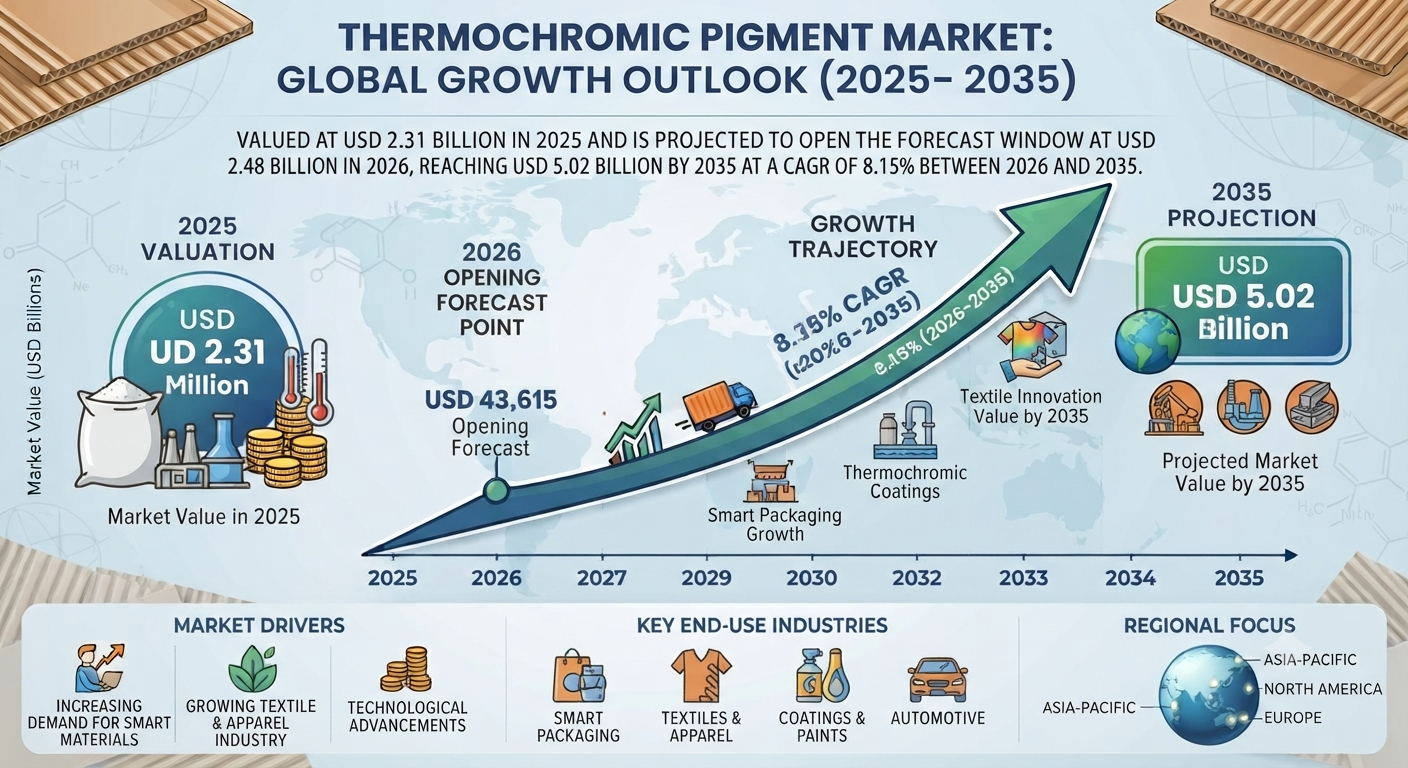

NEW YORK, NY, UNITED STATES, September 22, 2026 /EINPresswire.com/ — The global thermochromic pigment market is entering a period of strong expansion as temperature-responsive color technologies find growing applications across packaging, coatings, printing, textiles, automotive products, pharmaceuticals, and security solutions. According to the latest Market Research Future report, the market was valued at USD 2.31 billion in 2025 and is projected to reach USD 5.02 billion by 2035, expanding at a CAGR of 8.15% from 2026 to 2035. The market is expected to reach approximately USD 2.48 billion in 2026.
Thermochromic pigments change color in response to temperature variations. This functionality allows manufacturers to develop products that provide visual temperature indications, interactive designs, freshness cues, security features, and thermal-management capabilities.
Smart Packaging Creates New Growth Opportunities
One of the most significant growth areas for thermochromic pigments is smart packaging. Temperature-responsive indicators can provide consumers and supply-chain operators with visual information about temperature exposure, product condition, or freshness.
The growing focus on reducing food waste is encouraging packaging manufacturers to explore condition-indicating technologies. Pharmaceutical logistics is another important application, particularly for products that require controlled temperature conditions during transportation and storage.
These applications can create demand for irreversible thermochromic pigments, which provide a permanent indication after a specified temperature threshold has been reached.
Reversible Pigments Gain Momentum
The market is segmented into reversible and irreversible thermochromic pigments. Irreversible products accounted for 63.2% of market revenue in 2025, supported by applications such as cold-chain and sterilization indicators.
Meanwhile, reversible thermochromic pigments are projected to grow at a 9.15% CAGR through 2035. Their ability to repeatedly change color makes them suitable for applications in apparel, consumer packaging, automotive components, glazing, and other products where temperature changes occur repeatedly.
Advances in microencapsulation are helping manufacturers improve the durability and switching performance of reversible pigments, potentially expanding their use in demanding industrial applications.
Get Sample @ https://www.marketresearchfuture.com/sample_request/7409
Paints and Coatings Represent a Major Application
Paints and coatings accounted for 38.1% of market revenue in 2025, making the segment the largest application category in the current Market Research Future analysis.
Thermochromic coatings can provide visual temperature cues and are being explored for architectural, automotive, consumer, and specialty applications. Temperature-responsive exterior coatings may also have potential in building-envelope applications where changes in surface color can influence solar heat absorption.
The development of more durable formulations remains important, particularly for outdoor applications exposed to ultraviolet radiation and repeated temperature cycles.
Printing Inks Expand Beyond Promotional Applications
Thermochromic pigments are also increasingly incorporated into printing inks used for packaging, security printing, promotional products, labels, and authentication features.
The printing-ink segment generated approximately USD 0.54 billion in 2025, according to Market Research Future.
Security and anti-counterfeiting applications are particularly relevant because thermochromic effects can provide an additional visual authentication feature without requiring specialized electronic readers. A color response triggered by body heat or friction can be used as one element in a multilayer authentication system.
Pharmaceutical Cold Chains Support Demand
Temperature-sensitive pharmaceutical products represent another important opportunity. Thermochromic indicators can provide a relatively simple visual method for identifying whether a shipment has experienced an undesirable temperature excursion.
Market Research Future identifies cold-chain compliance mandates in pharmaceutical logistics as a major growth driver for the industry. The report also points to emerging cold-chain infrastructure in markets such as India, Brazil, and ASEAN countries as an opportunity for indicator technologies.
As pharmaceutical supply chains become more sophisticated, demand may increasingly shift toward indicators that combine temperature response with traceability and digital data systems.
Microencapsulation Improves Product Performance
Technological advances in microencapsulation are addressing some of the historical limitations of thermochromic pigments.
Newer capsule and shell technologies are being developed to improve resistance to processing temperatures, ultraviolet exposure, and repeated switching. These developments could make thermochromic pigments more suitable for plastics, automotive components, coatings, and other applications that previously presented technical challenges.
Improved fatigue resistance is particularly important for reversible products, where repeated temperature cycling can gradually reduce color-change performance.
Asia-Pacific Emerges as a High-Growth Region
North America held the largest regional share in 2025, accounting for approximately 31.4% of global thermochromic pigment revenue. Demand in the region is supported by pharmaceutical logistics, security printing, packaging, and specialty coatings.
However, Asia-Pacific is projected to register an 8.99% CAGR between 2026 and 2035, making it a major growth engine for the global industry. China and India are important contributors, supported by packaging conversion, textile manufacturing, pharmaceutical exports, and expanding cold-chain infrastructure.
Europe represented approximately 26.8% of the global market, with demand influenced by packaging sustainability, food-waste reduction, and building-efficiency initiatives.
Buy Now @ https://www.marketresearchfuture.com/checkout?currency=one_user-USD&report_id=7409
Sustainability and Chemical Regulation Influence Product Development
The industry is also facing increasing scrutiny of the chemical components used in thermochromic formulations. Regulatory attention toward certain bisphenol-based developer chemistries is encouraging manufacturers to investigate alternative formulations.
This is creating opportunities for bio-based and bisphenol-free developer chemistry. Companies capable of delivering compliant formulations without compromising color intensity, activation temperature, durability, or cost could gain opportunities in food packaging and other regulated applications.
Cost and Durability Remain Challenges
Despite strong growth prospects, thermochromic pigments face several technical and economic constraints. Their higher cost compared with conventional pigments can limit adoption in price-sensitive applications.
Outdoor durability is another challenge. Ultraviolet exposure and repeated thermal cycling can reduce performance, while some formulations have limitations at the elevated processing temperatures used in plastics manufacturing.
These challenges are encouraging manufacturers to invest in improved encapsulation, stabilizers, alternative developer chemistry, and more consistent production processes.
Emerging Opportunities in Smart Buildings and Electronics
Beyond conventional packaging and printing, thermochromic technology is finding potential applications in dynamic glazing, building-envelope materials, sensor films, and flexible electronics.
Temperature-responsive films and coatings could offer passive visual or thermal responses without requiring electronic controls. Market Research Future identifies dynamic glazing and building-envelope retrofits as an emerging opportunity, particularly as energy efficiency becomes a greater consideration in building design and renovation.
Printed thermal sensor films represent another developing area, combining thermochromic materials with printed electronics and potentially enabling low-cost temperature visualization in packaging, logistics, and wearable products.
Read More @ https://www.marketresearchfuture.com/reports/thermochromic-pigment-market-7409
Competitive Landscape
The global thermochromic pigment market includes specialized pigment and color-technology companies competing through formulation performance, encapsulation technology, product durability, activation-temperature precision, and application-specific solutions.
Key companies identified by Market Research Future include LCR Hallcrest LLC, Chromatic Technologies Inc., OliKrom SAS, Hali Industrial Co., Ltd., New Prismatic Enterprise Co., Ltd., and Kolortek Co., Ltd.
Competition is increasingly shifting toward specialized formulations rather than pigment production volume alone. Suppliers that can demonstrate consistent switching performance, regulatory compliance, durability, and compatibility with industrial processing are positioned to address higher-value applications.
Outlook to 2035
The thermochromic pigment market is projected to more than double from USD 2.31 billion in 2025 to USD 5.02 billion by 2035, reflecting the expanding use of temperature-responsive materials across packaging, manufacturers improve durability and reduce formulation costs, thermoch coatings, printing, textiles, pharmaceuticals, automotive products, and security applications.
Over the coming decade, market development is expected to be shaped by smart packaging, pharmaceutical cold-chain monitoring, advanced microencapsulation, sustainable chemistry, reversible pigments, and temperature-responsive building materials.
Browse More Reports:
Vinyl Acetate Monomer Market https://www.marketresearchfuture.com/reports/vinyl-acetate-monomer-market-6237
industrial wood adhesives market https://www.marketresearchfuture.com/reports/industrial-wood-adhesives-market-40036
laminated steel market https://www.marketresearchfuture.com/reports/laminated-steel-market-36407
Biocides Market https://www.marketresearchfuture.com/reports/biocides-market-6502
Lithium-Ion Battery Cathode Material Market https://www.marketresearchfuture.com/reports/lithium-ion-battery-cathode-material-market-12393
automotive engine oil market https://www.marketresearchfuture.com/reports/automotive-engine-oil-market-35436
ceramic substrate market https://www.marketresearchfuture.com/reports/ceramic-substrate-market-29393
Market Research Future
Market Research Future
+1 855-661-4441
email us here
Legal Disclaimer:
EIN Presswire provides this news content “as is” without warranty of any kind. We do not accept any responsibility or liability
for the accuracy, content, images, videos, licenses, completeness, legality, or reliability of the information contained in this
article. If you have any complaints or copyright issues related to this article, kindly contact the author above.

Media gallery